# ArrayList
# ArrayList也这么多知识?
Array + List = 数组 + 列表 = ArrayList = 数组列表
# 初始化
List<String> list = new ArrayList<String>(10);

public ArrayList() {
    this.elementData = DEFAULTCAPACITY_EMPTY_ELEMENTDATA;
}

 /**
  * Constructs an empty list with the specified initial capacity.
  *
  * @param  initialCapacity  the initial capacity of the list
  * @throws IllegalArgumentException if the specified initial capacity
  *         is negative
  */
 public ArrayList(int initialCapacity) {
     if (initialCapacity > 0) {
         this.elementData = new Object[initialCapacity];
     } else if (initialCapacity == 0) {
         this.elementData = EMPTY_ELEMENTDATA;
     } else {
         throw new IllegalArgumentException("Illegal Capacity: "+
                                            initialCapacity);
     }
 }
1
2
3
4
5
6
7
8
9
10
11
12
13
14
15
16
17
18
19
20
21
22
23
2
3
4
5
6
7
8
9
10
11
12
13
14
15
16
17
18
19
20
21
22
23
- 通常情况空构造函数初始化ArrayList更常用,这种方式数组的长度会在第一次插入数据时候进行设置。
- 当我们已经知道要填充多少个元素到ArrayList中,比如500个、1000个,那么为了提供性能,减少ArrayList中的拷贝操作,这个时候会直接初始化一个预先设定好的长度。
- 另外,EMPTY_ELEMENTDATA 是一个定义好的空对象;private static final Object[] EMPTY_ELEMENTDATA = {}
# 插入
ArrayList对元素的插入,其实就是对数组的操作,只不过需要特定时候扩容。 当我们依次插入添加元素时,ArrayList.add方法只是把元素记录到数组的各个位置上了,源码如下;
/**
 * Appends the specified element to the end of this list.
 *
 * @param e element to be appended to this list
 * @return <tt>true</tt> (as specified by {@link Collection#add})
 */
public boolean add(E e) {
    ensureCapacityInternal(size + 1);  // Increments modCount!!
    elementData[size++] = e;
    return true;
}
1
2
3
4
5
6
7
8
9
10
11
2
3
4
5
6
7
8
9
10
11
这是插入元素时候的源码,size++自增,把对应元素添加进去。
# 插入时扩容
在前面初始化部分讲到,ArrayList默认初始化时会申请10个长度的空间,如果超过这个长度则需要进行扩容,那么它是怎么扩容的呢?
从根本上分析来说,数组是定长的,如果超过原来定长长度,扩容则需要申请新的数组长度,并把原数组元素拷贝到新数组中,如下图;
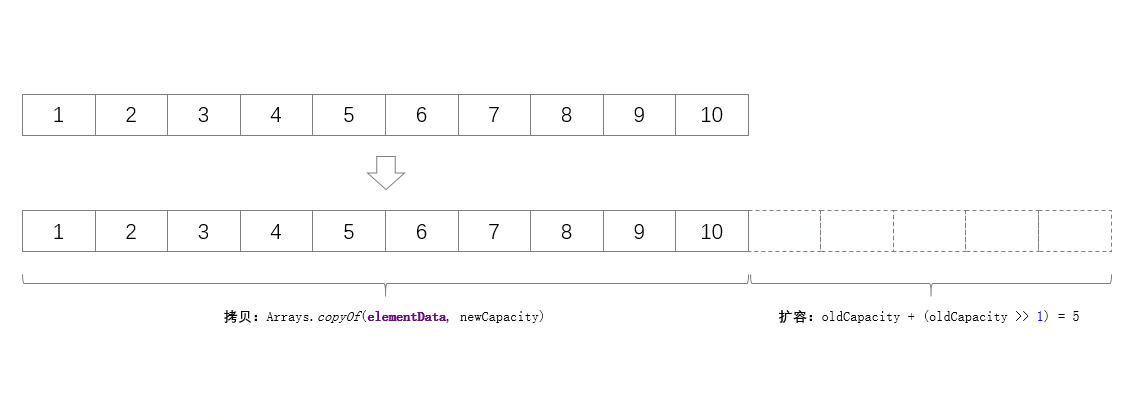 图中介绍了当List结合可用空间长度不足时则需要扩容,这主要包括如下步骤;
- 判断长度充足;ensureCapacityInternal(size + 1);
- 当判断长度不足时,则通过扩大函数,进行扩容;grow(int minCapacity)
- 扩容的长度计算;int newCapacity = oldCapacity + (oldCapacity >> 1);,旧容量 + 旧容量右移1位,这相当于扩容为原来容量的(int)3/2。 4. 10,扩容时:1010 + 1010 >> 1 = 1010 + 0101 = 10 + 5 = 15 2. 7,扩容时:0111 + 0111 >> 1 = 0111 + 0011 = 7 + 3 = 10
- 当扩容完以后,就需要进行把数组中的数据拷贝到新数组中,这个过程会用到Arrays.copyOf(elementData, newCapacity);,但他的底层用到的是;System.arraycopy
@Test
public void test_arraycopy() {
    int[] oldArr = {1, 2, 3, 4, 5, 6, 7, 8, 9, 10};
    int[] newArr = new int[oldArr.length + (oldArr.length >> 1)];
    System.arraycopy(oldArr, 0, newArr, 0, oldArr.length);

    newArr[11] = 11;
    newArr[12] = 12;
    newArr[13] = 13;
    newArr[14] = 14;

    System.out.println("数组元素:" + JSON.toJSONString(newArr));
    System.out.println("数组长度:" + newArr.length);

    /**
     * 测试结果
     *
     * 数组元素:[1,2,3,4,5,6,7,8,9,10,0,11,12,13,14]
     * 数组长度:15
     */
}
1
2
3
4
5
6
7
8
9
10
11
12
13
14
15
16
17
18
19
20
21
2
3
4
5
6
7
8
9
10
11
12
13
14
15
16
17
18
19
20
21
- 拷贝数组的过程并不复杂,主要是对System.arraycopy的操作。
- 上面就是把数组oldArr拷贝到newArr,同时新数组的长度,采用和ArrayList一样的计算逻辑;oldArr.length + (oldArr.length >> 1)
# 指定位置插入
容量验证
public void add(int index, E element) {
    rangeCheckForAdd(index);

    ...
}

private void rangeCheckForAdd(int index) {
    if (index > size || index < 0)
        throw new IndexOutOfBoundsException(outOfBoundsMsg(index));
}
1
2
3
4
5
6
7
8
9
10
2
3
4
5
6
7
8
9
10
- 指定位置插入首先要判断rangeCheckForAdd,size的长度。
- 通过上面的元素插入我们知道,每插入一个元素,size自增一次size++。
- 所以即使我们申请了10个容量长度的ArrayList,但是指定位置插入会依赖于size进行判断,所以会抛出IndexOutOfBoundsException异常。
# 元素迁移
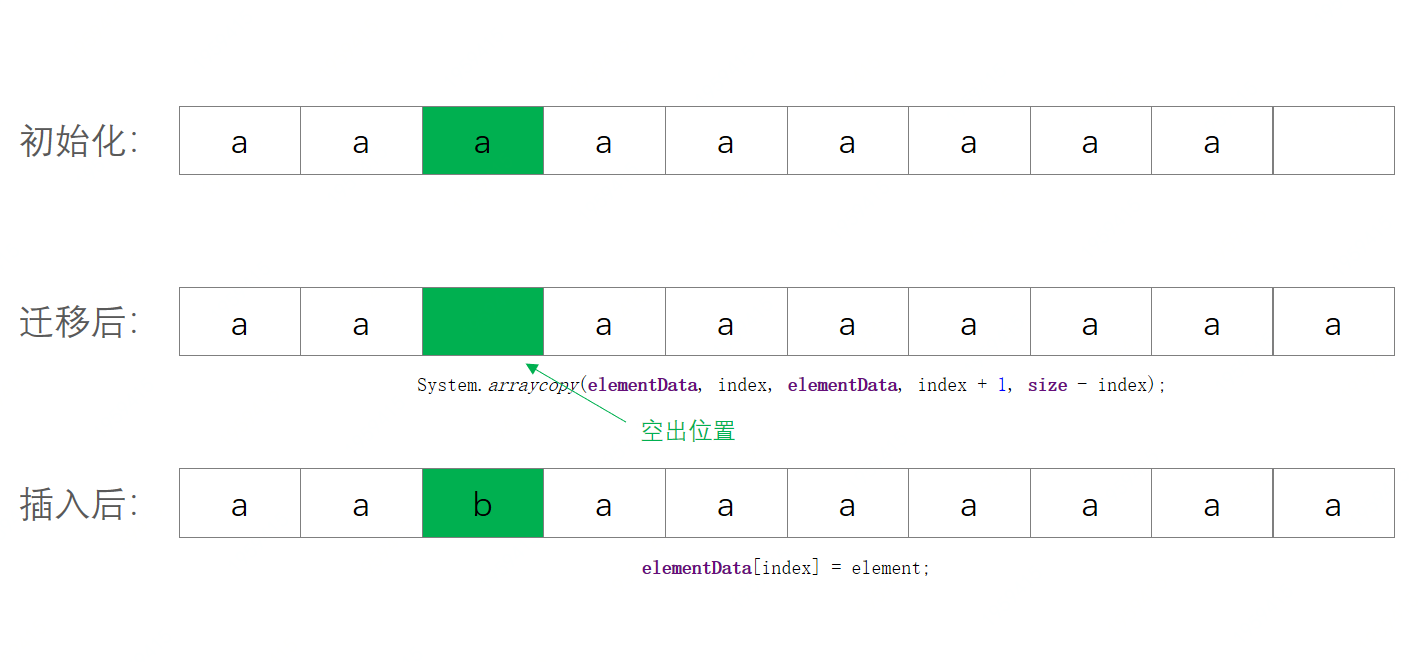 指定位置插入的核心步骤包括;
- 判断size,是否可以插入。
- 判断插入后是否需要扩容;ensureCapacityInternal(size + 1);。
- 数据元素迁移,把从待插入位置后的元素,顺序往后迁移。
- 给数组的指定位置赋值,也就是把待插入元素插入进来。
public void add(int index, E element) {
	...
	// 判断是否需要扩容以及扩容操作
	ensureCapacityInternal(size + 1);
    // 数据拷贝迁移,把待插入位置空出来
    System.arraycopy(elementData, index, elementData, index + 1,
                     size - index);
    // 数据插入操作
    elementData[index] = element;
    size++;
}
1
2
3
4
5
6
7
8
9
10
11
2
3
4
5
6
7
8
9
10
11
- 这部分源码的主要核心是在,System.arraycopy,上面我们已经演示过相应的操作方式。
- 这里只是设定了指定位置的迁移,可以把上面的案例代码复制下来做测试验证。
# 删除
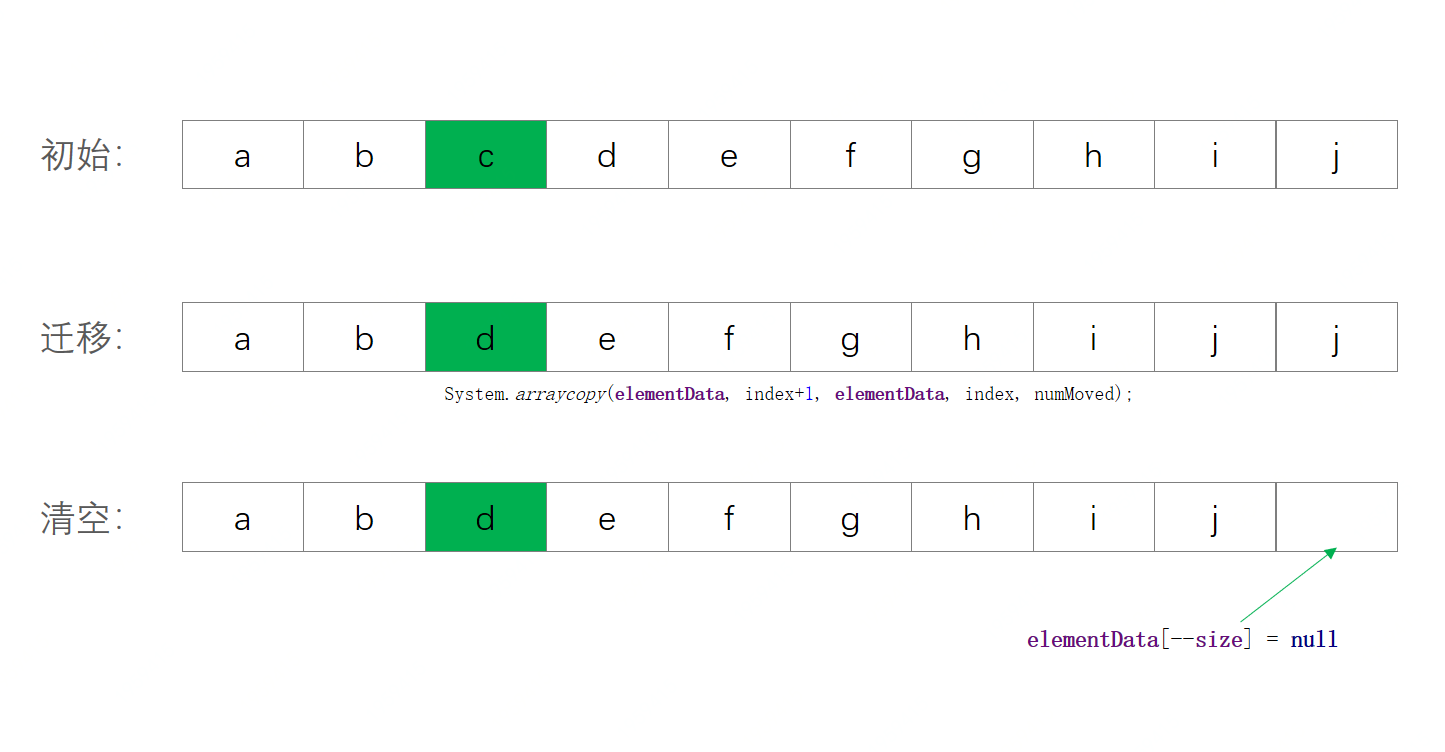
有了指定位置插入元素的经验,理解删除的过长就比较容易了,如下图;
public E remove(int index) {
    rangeCheck(index);
    modCount++;
    E oldValue = elementData(index);
    int numMoved = size - index - 1;
    if (numMoved > 0)
        System.arraycopy(elementData, index+1, elementData, index,
                         numMoved);
    elementData[--size] = null; // clear to let GC do its work
    return oldValue;
}
1
2
3
4
5
6
7
8
9
10
11
2
3
4
5
6
7
8
9
10
11
删除的过程主要包括;
- 校验是否越界;rangeCheck(index);
- 计算删除元素的移动长度numMoved,并通过System.arraycopy自己把元素复制给自己。
- 把结尾元素清空,null。